


Many of us have experienced that feeling of driving from A to B and arriving at our destination with no recollection of the journey. In the same way, we can balance when riding a bike, co-ordinate movement to play a tune on an instrument or type on a keyboard without looking. Muscle memory enables us to switch to autopilot and – without even realising it – the body takes full control.
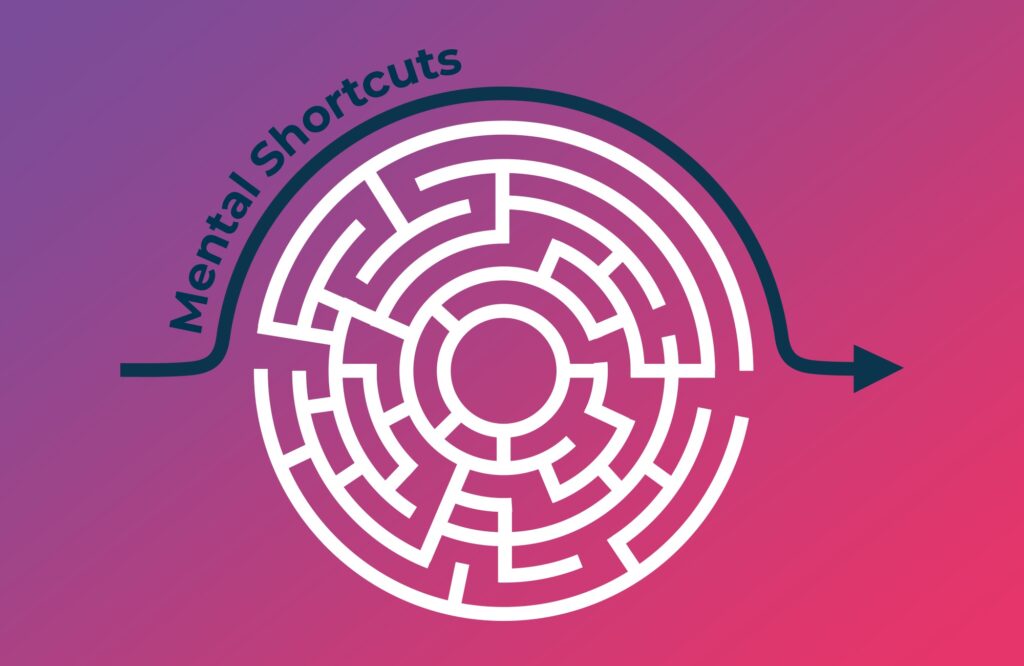
Our minds can function in a similar way. We take mental shortcuts to arrive at decisions without fully investing time into considering our options. These mental shortcuts – heuristics – facilitate problem-solving and probability judgements by allowing us to reduce mental effort and simplify complex questions or decisions without having to constantly stop and think about the next course of action.
Customers face an overwhelming array of decisions about the products and services they buy, so it’s inevitable that heuristics will come into play. By identifying and understanding the typical mental shortcuts involved, you can look for ways to influence customer behaviour.

People make decisions based on comparisons and assumptions
When people come to a conclusion by comparing the event or object to something similar that already exists in their mind, rather than using statistics and knowledge, this is known as a representative heuristic.
For example, imagine Rachael. She’s 30, married, intelligent, outspoken and opinionated. She enjoys visiting museums, playing chess and watching the news. Do you think Rachael is a lawyer or supermarket assistant? Take a guess. A large proportion of people would choose the first option because her description matches a stereotype we associate with lawyers. There’s no research we’ve completed to come to this conclusion, we’ve just made comparisons and judgements from things that already exist in our minds.
In the same way we assumed what Rachael’s job role was, people sometimes think the relationship between value and size directly relates to one another, and make decisions based on that. For example, you may see a pile of one thousand 1p coins and assume it’s worth more than a £10 note. This is the same for point-based loyalty programmes. By disassociating the points-to-monetary value the perceived value of the rewards redeemed can feel much higher than the actual monetary value of the awarded points.
Accor Hotels’ Le Club programme used the representative heuristic in a four-week ‘Million Points Giveaway’. One million points sounds like a lot, so it was a great headline that generated massive interest. But in fact, the cost to the hotel was less than 10,000 euros.
When people are exposed to various promotions, they can form opinions based on the previous information they’ve consumed. For example, if your competitors are regularly offering discounts and rebates, this can diminish the perceived product value and quality as as the customer may very well expect this offer every time going forward.
By researching customer touchpoints to see how your product information is consumed, you can ensure that your message is perceived as you originally intended.
It’s easy to bring something to mind that affects decision making
You’re in the local shop buying some ingredients to make brownies. The recipe says ‘good-quality chocolate’ but doesn’t specify a brand. You immediately pick up a bar of Cadbury’s without even considering the other brands. This is known as the availability heuristic – the mental shortcut that focuses on how easy it is to bring something to mind. If you had read the packaging of each brand, you may have selected a different option, but instead you chose the one that came to mind instantly. It’s human nature.
Whether in a B2C or B2B situation, this heuristic is closely linked to brand awareness. Which is why you need to ensure your brand is front of mind rather than your competitor’s – and this is where loyalty programmes deliver value. When you recognise and reward certain behaviours, such as repeat purchases, customers become far more likely to choose your brand. In fact, 79% of consumers say loyalty programmes make them more likely to continue doing business with brands.
People’s emotions also influence decision making
We all have those days where we wake up on the wrong side of the bed – from there onwards it’s a downward spiral. Everything seems to go wrong and nothing is on your side. Whether it’s the hot water not working in the morning, the coffee shop running out of your go-to or every traffic light being red when you are already running late. Making decisions when you’re in this state of mind may be somewhat risky. If your emotions are high, you may not be thinking logically.
Conversely on other days you wake up with a spring in your step and you’re raring to go. You’ve had a great workout at the gym, the coffee shop guy gave you a free croissant and there was no traffic on the road – bonus! Your mind is ready for the day ahead.
It may come as no surprise to learn that emotions influence decision making and can be used as a mental shortcut. Research shows that when we’re in a positive emotional state, we’re more likely to make decisions with low risks and high benefits. When we’re in a negative emotional state, we’re more inclined to make decisions that are low in benefits but high in risk. If you’ve ever gone with your gut feeling when faced with a difficult decision, you are probably relying on the affect heuristic.
Loyalty programmes harness this mental shortcut. Building long-term loyalty is all about developing emotional connections. When a customer feels a positive connection and is invested in your brand’s values and beliefs, they are far more likely to remain loyal.
The first piece of information can make all the difference
Customers tend to make a judgement or form an opinion based on the first piece of information they receive. This information is the reference point for future purchases and they base their entire purchasing decision on that, regardless of whether it’s accurate or not. This can sometimes result in purchases the customer regrets or a bad experience! This is known as the anchoring heuristic.
This mental shortcut can be a bit daunting for marketers because (as the old adage says) the first impression makes all the difference. Your brand has one shot to get it right first time and this can be the deal-breaker between you winning the business over competitors.
Marketing professionals also need to consider the anchoring heuristic when offering discounts or promoting new products. If a consumer’s first purchase with you is when a product is on offer, they might feel a little annoyed when they re-purchase at a later date and see its full price. Remember, offering discounts can diminish the perceived product value and quality, so when the discount expires, customers may shop around.
An understanding of heuristics can help you influence behaviour
While mental shortcuts can help speed up the decision-making process, people can also make inaccurate judgements and decisions that they wouldn’t have made if more time (and conscious attention) was invested. The value for businesses lies in understanding these heuristics and using them to change and influence behaviour. For loyalty programmes to genuinely impact business and individual performance they must be seen and used as an integral part of your marketing mix; not seen as an add-on. Audience engagement, participation and business performance will then take a steady progressive step forward.
Be aware of your own mental shortcuts when thinking about how to reward and recognise your customer behaviour. It’s easy to be distracted with the cheapest, simplest solution to reward your customers, but long-term loyalty comes from harnessing emotional connections at every point. Your customer touchpoint insight will enrich your knowledge, so don’t be short sighted and leave yourself short-changed with a quick fix solution. This is where our behavioural expertise plays an important part in helping clients to change behaviours to drive long-term results.